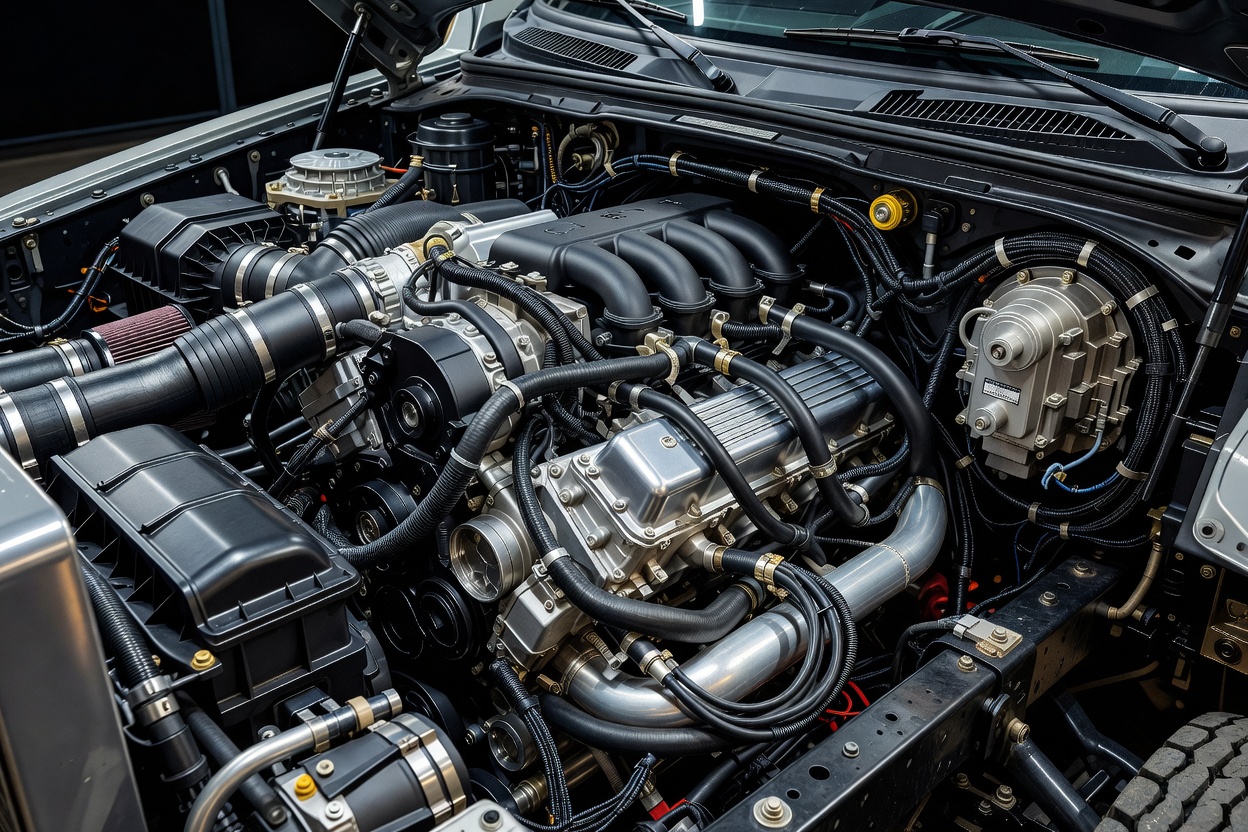
When specifying a truck for heavy hauling, the foundational choice between a diesel (compression-ignition) and gas (spark-ignition) engine determines the vehicle's capability, longevity, and total cost of ownership. The industry default for payloads exceeding 10,000 lbs has historically been diesel, but modern heavy-duty gas engines have closed the gap in specific applications.
Thermal Efficiency and Fuel Density
The primary advantage of a diesel engine lies in its thermal efficiency. Diesel fuel contains approximately 10-15% more energy per gallon than gasoline. Furthermore, diesel engines operate at much higher compression ratios—typically between 15:1 and 17:1, compared to 9:1 to 11:1 for gasoline engines.
This high compression allows the engine to extract more mechanical work from the same volume of fuel. Because diesel engines do not use a throttle plate to regulate air intake (they run unthrottled), they suffer from significantly lower pumping losses at part-load compared to gas engines, leading to superior fuel economy, particularly under heavy strain.
The Torque Curve
Horsepower is a function of torque and engine speed (RPM). Gas engines typically generate peak horsepower and torque higher in the RPM band. While this is excellent for rapid acceleration in an unloaded vehicle, it is counterproductive when moving 20,000 lbs from a dead stop.
Diesel engines generate massive torque at low engine speeds (often peaking between 1,400 and 1,800 RPM). This is achieved through a combination of:
- Long piston strokes that increase mechanical leverage on the crankshaft.
- Forced induction (virtually all modern truck diesels are turbocharged).
- High-pressure direct injection systems that atomize fuel perfectly for the dense, compressed air environment.
This low-end torque allows heavy trucks to maintain speed on steep grades without constantly downshifting, reducing wear on the transmission and keeping engine temperatures stable.
Hardware Durability
Because diesel engines must withstand immense internal cylinder pressures, their foundational components are heavily overbuilt. Engine blocks are cast from high-strength iron or compacted graphite iron (CGI). Crankshafts are forged steel, held in place by deep-skirt blocks and massive main bearing caps. Connecting rods and pistons are substantially thicker than their gasoline counterparts.
This robust construction is why commercial diesel engines are frequently rated for a B50 life (the point at which 50% of the engines will require a major overhaul) of 350,000 to 500,000 miles, whereas heavy-duty gas engines typically target a B50 life of 200,000 to 250,000 miles.
| Metric | Heavy-Duty Diesel | Heavy-Duty Gas |
|---|---|---|
| Compression Ratio | 15:1 - 17:1 | 9:1 - 11:1 |
| Peak Torque RPM | 1,400 - 1,800 | 3,800 - 4,200 |
| B50 Lifespan (Avg) | 400,000+ miles | 200,000+ miles |
| Upfront Cost Premium | High ($8k - $12k) | Base |
| Emissions Complexity | High (DPF, DEF, EGR) | Low (Cats, EGR) |
The Case for Gas Engines
Despite the physical advantages of diesel, heavy-duty gas engines have seen a resurgence in fleet operations. The primary driver is emissions compliance and upfront cost. Modern diesel engines require complex exhaust aftertreatment systems, including Diesel Particulate Filters (DPF) and Selective Catalytic Reduction (SCR) utilizing Diesel Exhaust Fluid (DEF).
These systems are expensive to maintain and are prone to clogging if the truck is used for short trips or prolonged idling. A gas engine, utilizing standard catalytic converters, avoids this complexity entirely. For vocational trucks, snow plows, or local delivery vehicles that rarely tow at maximum capacity, a gas engine offers a lower initial purchase price and simplified maintenance, offsetting the fuel economy penalty.
Selection Criteria
If your application requires towing loads exceeding 15,000 lbs daily, over long highway distances, the torque and thermal efficiency of a diesel engine are non-negotiable. However, for payloads under 10,000 lbs, local routes, or applications with high idle times, modern high-displacement gas engines provide a financially pragmatic alternative that eliminates exhaust aftertreatment headaches.